
“The Boys” showrunner Eric Kripke likes really big, bold starts to seasons, ones that propel characters into places that are completely different at the start of a new season to where they were at the end of the old one. Showrunner Michele Fazekas, who helmed Season 2 of Prime Video’s spinoff “Gen V” had to take that approach to heart and then some. Season 2 of the series still circles around “God U,” aka the Godolkin University School of Crimefighting, a college for superheroes that, true to the universe of “The Boys,” represents some of Charles Xavier’s darkest nightmares. But with the tragic death of core cast member Chance Perdomo between seasons, nothing that the friends of Andre Anderson faced could be close to the same.
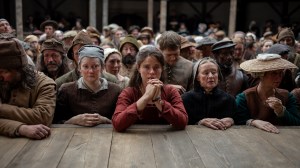
The solutions that “Gen V” Season 2 finds lean into and expand on the show’s core interest in the big first loves and messy emotions that are part of coming of age. While of course there is a mystery to unravel about the new God U dean, Cipher (Hamish Linklater) and leveled-up power sets appropriated to the fucked-up sophomore year of on-the-lam bloodbender Marie Moreau (Jaz Sinclair), Sam (Asa Germann) and Cate (Maddie Phillips), her friends who stayed loyal to Homelander, and Emma (Lizzie Broadway) and Jordan (both London Thor and Derek Luh), the friends who got caught. “You really do start with a character. Like, what is the real way that these people would react [and] then you build from there,” Fazekas told IndieWire.
The structure Fazekas and her team developed in the writers’ room, the coordination of visceral fights and even more cinematic feelings by producing director (and stunts legend) Steve Boyum, and the visual, ultraviolent superheroes coordinated by VFX supervisor Karen Heston, all find ways to transition between saving the world and saving a relationship, the large-scale and the intimate, with the initable social satire “Gen V” and “The Boys” are known for. The Season 2 finale, “Trojan,” is true to its title in many respects, including sneaking in a musical number in a bunker with just a ton of (CG, of course) blood on the floor.
In the videos below, watch how Fazekas, Boyum, and Heston manage character, scale, and superhero powers to give “Gen V” its signature blend of big genre setpieces, wicked humor, and heart.
The Writing of ‘Gen V’
Part of the fun of having such an ensemble show like “Gen V,” for a writer, is getting to play with a variety of characters for each of the core group. Marie has some sort of chosen one thing going on — briefly bringing back the horribly burned and also horribly deranged Thomas Godolkin (Ethan Slater) kinda signals that. But Fazekas and her writing team always aimed, even when dealing with the most outlandish of superheroes, to explore the kinds of insecurities and desires that really do help us grow into better versions of ourselves as we grow up.
A great example of this is with Emma, whose powers can already grow her big or shrink her very very tiny as her emotions (and appetite for pizza) sometimes dictate. “Her character was always about what other people thought of her. She was always checking to see what did other people think; then I know how to move forward. And it was really important to us [to] let her define herself, not in relation to other people, but who is she?” Fazekas said.
Fazekas is also proud of the story the show is able to tell with Jordan, whose power is that they are bi-gender, and the character moves between two actors of different gender presentations quite fluidly. “ They always say, ‘every story has been told.’ I’m not sure this story has been told,” Fazekas said. “[Science fiction and fantasy] is such a great way to make social commentary without seeming like you’re lecturing because you’re putting it through this lens of outrageous stuff that doesn’t exist. And for some reason, it makes the social commentary easier to take in.”
In the video above, watch how the writing team of “Gen V” helps us take in real lessons through outrageous superpowers.
The Directing of ‘Gen V’
“Gen V” certainly doesn’t settle down into its sophomore year. Steve Boyum, who came to the series from “The Boys” and directed Episodes 1, 2, and 8 of Season 2, finessed the visual language of the series to be something that is not as frenetic and gleefully gritty as its sister series. In leaning away from jitters of cinema verite, Boyum finds other ways to capture the jitters of college — especially once you’re invited to a death bunker where you have to fight kind of an immortal sociopath who can puppet you with his mind. The work that Boyum did in Episode 8, “Trojan,” required a kind of gremlin-ish blocking, set off against a stately and classically cinematic approach to the camera. The discord in the frame is part of the drama — and also very much part of the fun.
“ You’re taking the, these very serious scenarios, you know, violent fight scenes or kids dealing with adolescent issues. And then you drop in these totally absurd things that happen, which “The Boys” does, I think as well, but I tend to think we even took it to another level [on ‘Gen V’],” Boyum told IndieWire. “ The big scene was obviously to get all of these kids — there’s like 20 of them in the room — to work in synchronicity [for the puppeting]. I knew what I wanted it to look like, and I knew how I wanted to shoot it. But you’re discovering a lot of it in the moment… How do I trick everybody into doing the same thing? And actually, at least for me, it feels like magic sometimes.”
In the video above, watch how Boyum worked his magic with the look and the cast of “Gen V.”
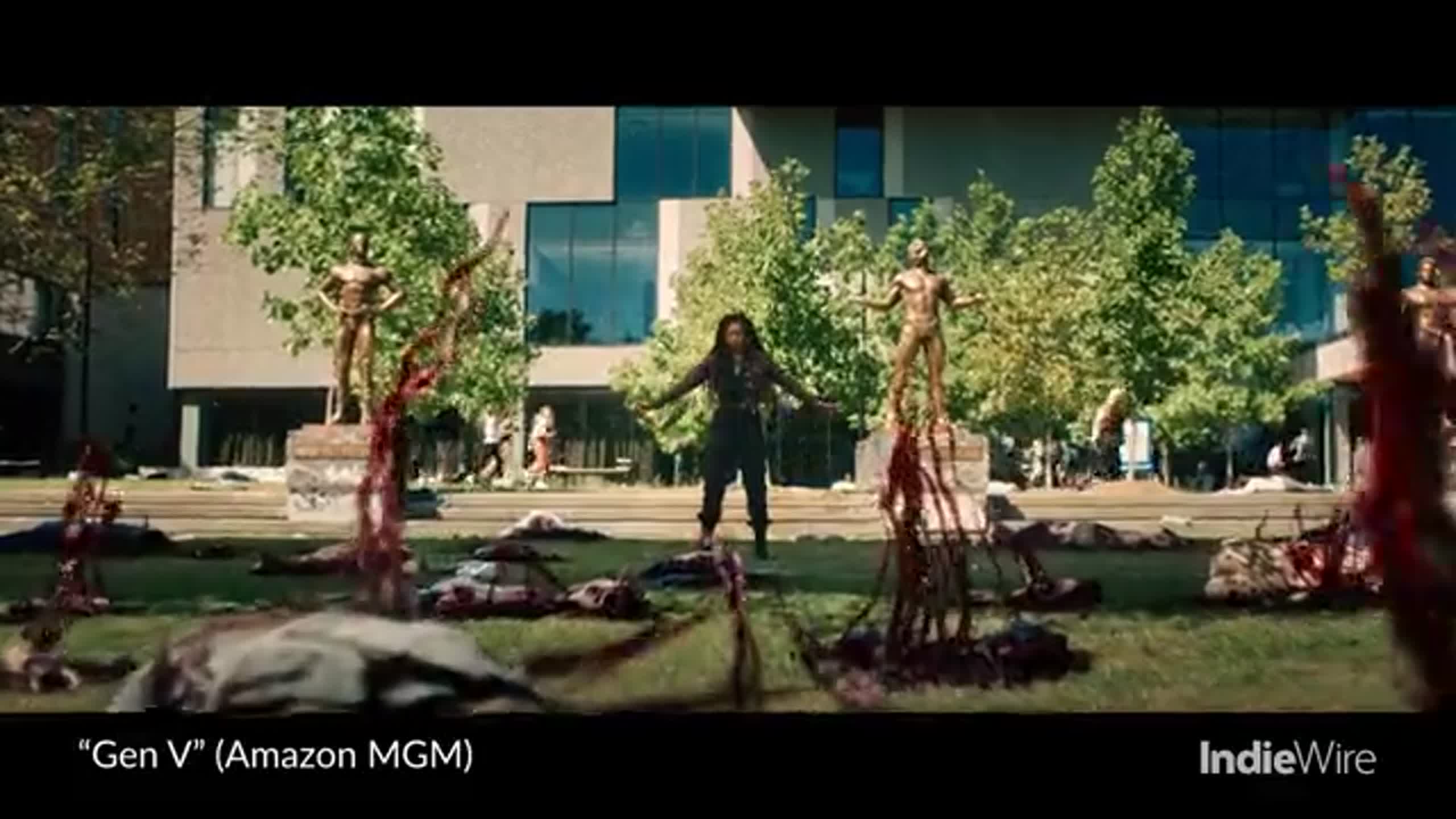
The Visual Effects of ‘Gen V’
The VFX demands on a show like “Gen V” are pretty high to start with, and doing them well requires starting quite early. Whether dealing with Marie’s blood darts, or a suddenly giant water pipe for Tiny Emma, or even the intensity of the fire that “killed” Thomas Godolkin, VFX supervisor Karen Heston and her team stressed the importance of being able to find solutions in pre-production or production that would make their work in post sing (no pun intended towards the dance scene in Episode 8).
Again, Emma and her powers are a great example of how VFX is never just the solution, but a set of tools that work with costume and production design to make something that’s physically impossible look feasible. When Emma shrinks, everything — from the floor, the props, the clothes, everything — has to scale up. Those Emma-scale objects can’t just be filled in later, either.
“ Whenever Emma was interacting with something, she was actually touching something. The production designer [Britt Doughty] really collaborated. We weren’t just in a blue screen and everything was blue and she was holding blue objects. There were actual surfaces for her to touch and engage with,” Heston said. “And the camera team — [director of photography] Jonathon Cliff did an amazing job collaborating with us, making sure we did a lot of research and lighting studies. What does the light quality look like if you’re that small? It’s not just the same studio lighting as if you’re normal.”
Tactility, in as much of the physical world as possible and in the lighting, are really important to how the VFX balances the superpower elements with the overall look of the show. They don’t just want ray blasts that look like nothing. “We worked really hard with our cinematographers and the gaffers and everyone, that if there is a special lighting moment, if there’s gonna be a big blast from Jordan, should we do interactive lighting or not? Should we do a pass or not? We had a few tertiary characters that had electricity powers. So do we wanna get that in our environment on the day?”
In the video above, watch how the “Gen V” VFX team handled every scale of challenge, from electrical blasts to torrents of blood. — Sarah Shachat
This article is presented in partnership with Amazon Studios.